Best Exercises For Golfers Elbow Do These Daily Alleviate The Pain
Best Exercises for Golfers Elbow
Best exercises for golfers elbow are often one of the most effective and natural ways to reduce pain, restore movement, and rebuild strength over time. If you’ve been dealing with discomfort on the inside of your elbow—especially when gripping, lifting, or bending your arm—you’re not alone. Golfer’s elbow (medial epicondylitis) is a common overuse condition, but with the right approach, it can be managed successfully.
This guide walks you through the most effective exercises, why they work, and what else you can do to support recovery.
What Is Golfer’s Elbow and Why It Happens
Golfer’s elbow develops when the tendons that attach to the inside of your elbow become irritated due to repetitive stress.
This often comes from gripping, lifting, or repetitive wrist movements.
Unlike tennis elbow (which affects the outer elbow), this condition targets the inner side and can make everyday activities surprisingly difficult.
For a deeper understanding of symptoms and causes, see
👉 how to relieve golfers elbow pain
Why Exercises Are Key to Recovery
The reason best exercises for golfers elbow are so important is simple:
- They improve blood flow to damaged tissue
- Help rebuild tendon strength
- Reduce stiffness and improve flexibility
- Gradually restore normal function
Avoiding movement completely can actually slow recovery. The goal is controlled, progressive loading—not rest alone.
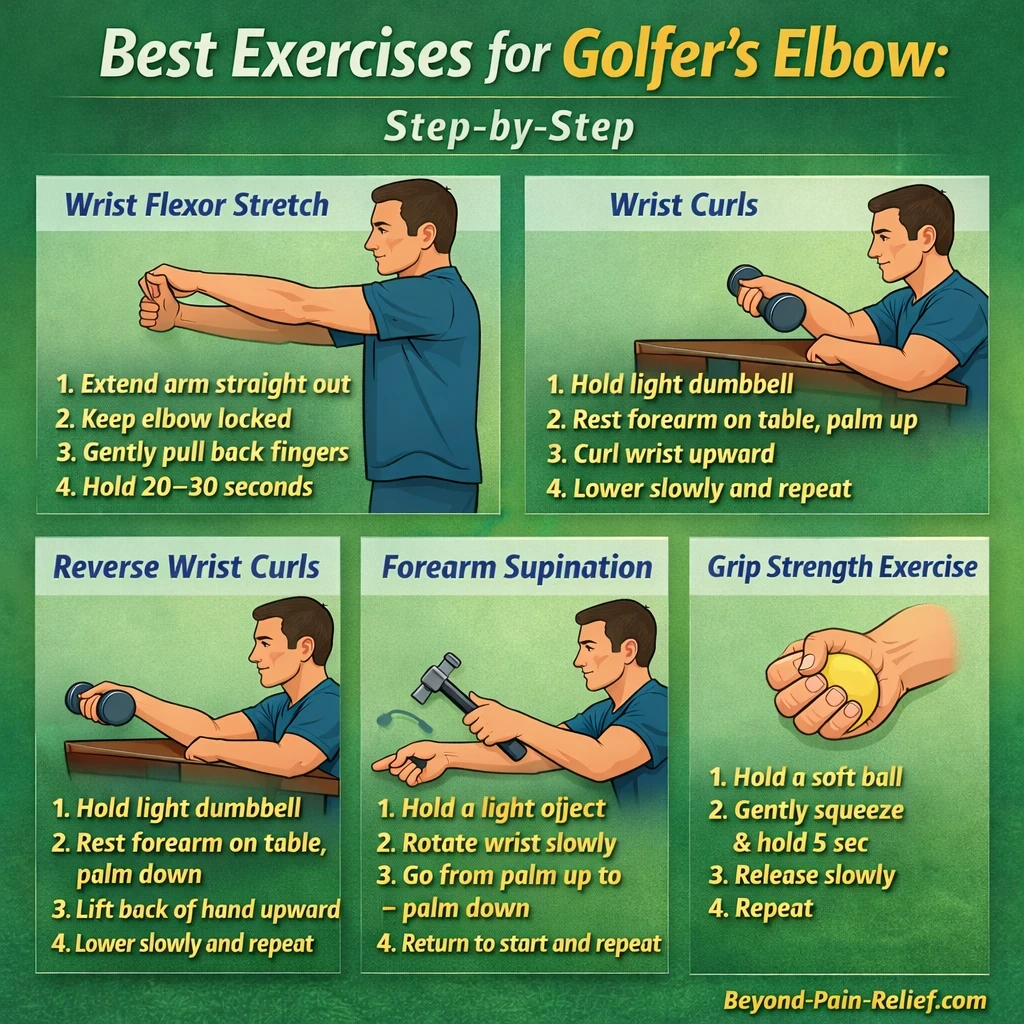
Best Exercises for Golfers Elbow (Step-by-Step)
These are some of the most effective exercises you can start with. Always begin gently and stop if pain becomes sharp.
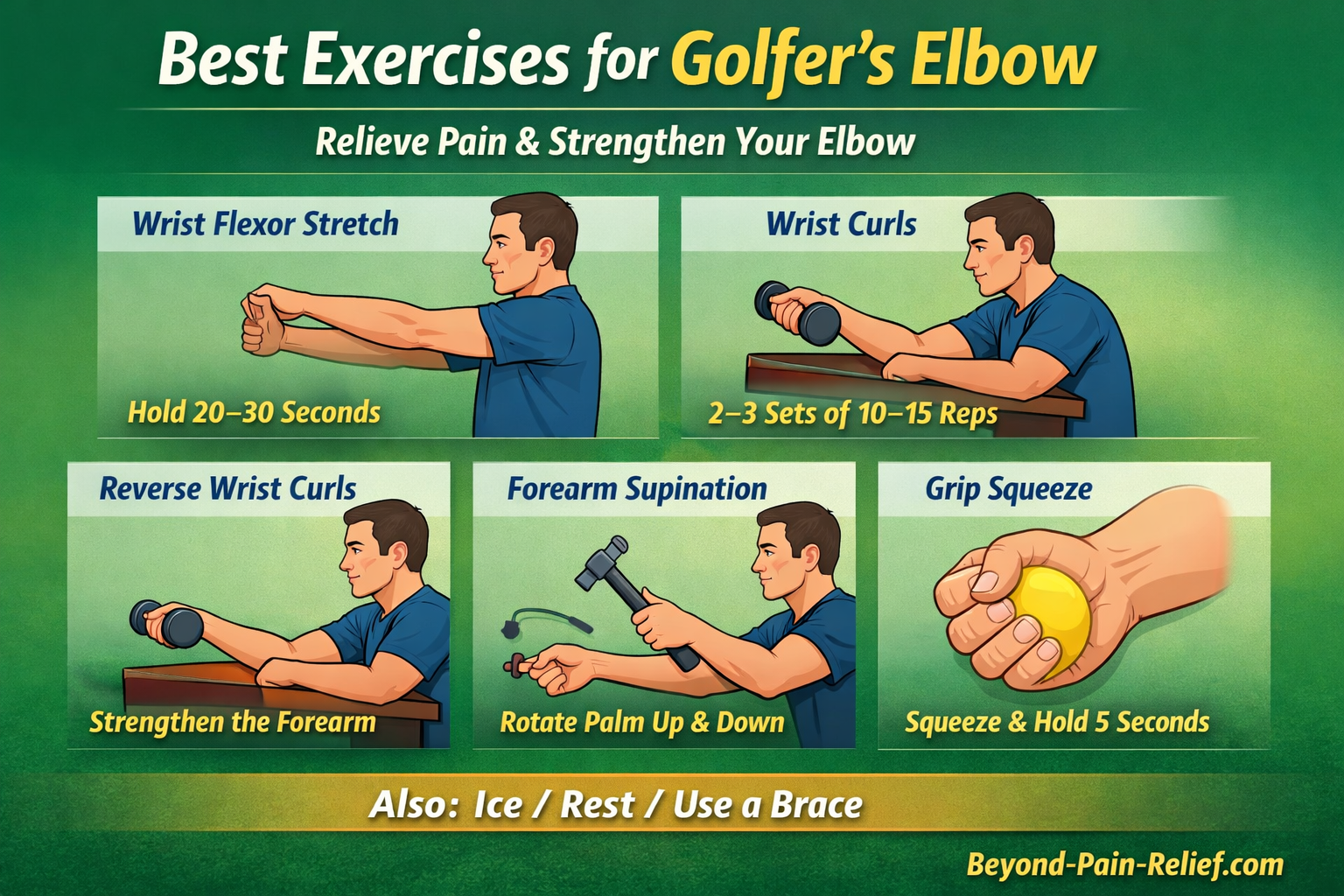
1. Wrist Flexor Stretch
This is one of the simplest yet most effective starting points.
How to do it:
- Extend your arm straight in front of you
- Use your other hand to gently pull your fingers back
- Keep your elbow straight
- Hold for 20–30 seconds
Why it works:
It stretches the tendon area that is typically tight and irritated.
2. Wrist Curls (Light Resistance)
This builds strength in a controlled way.
How to do it:
- Hold a light dumbbell (or even a water bottle)
- Rest your forearm on a table, palm facing up
- Slowly curl your wrist upward, then lower it
Reps: 10–15, 2–3 sets
Tip: Start very light. Progress slowly.
3. Reverse Wrist Curls
This balances strength on both sides of the forearm.
How to do it:
- Same position as above, but palm facing down
- Lift the back of your hand upward
- Lower slowly
This prevents muscle imbalance, which is often a hidden cause of recurring pain.
4. Forearm Pronation and Supination
This improves rotational strength and control.
How to do it:
- Hold a light object (like a hammer)
- Rotate your wrist slowly from palm up to palm down
- Keep movement controlled
Why it matters:
Many daily tasks involve rotation—this helps restore normal function.
5. Grip Strength Exercise
Weak grip strength can contribute to strain.
How to do it:
- Use a soft stress ball or grip trainer
- Squeeze gently and hold for 5 seconds
- Release slowly
Avoid overdoing this—too much gripping too soon can aggravate symptoms.
How Often Should You Do These Exercises?
Consistency matters more than intensity.
- Start with 3–4 times per week
- Keep sessions short (10–15 minutes)
- Gradually increase resistance over time
If pain increases the next day, scale back slightly.
Common Mistakes to Avoid
Even with the best exercises for golfers elbow, mistakes can slow progress:
- Doing too much too soon
- Using weights that are too heavy
- Ignoring proper form
- Skipping warm-up or stretching
- Stopping completely when mild discomfort appears
A small amount of discomfort is normal—but sharp pain is not.
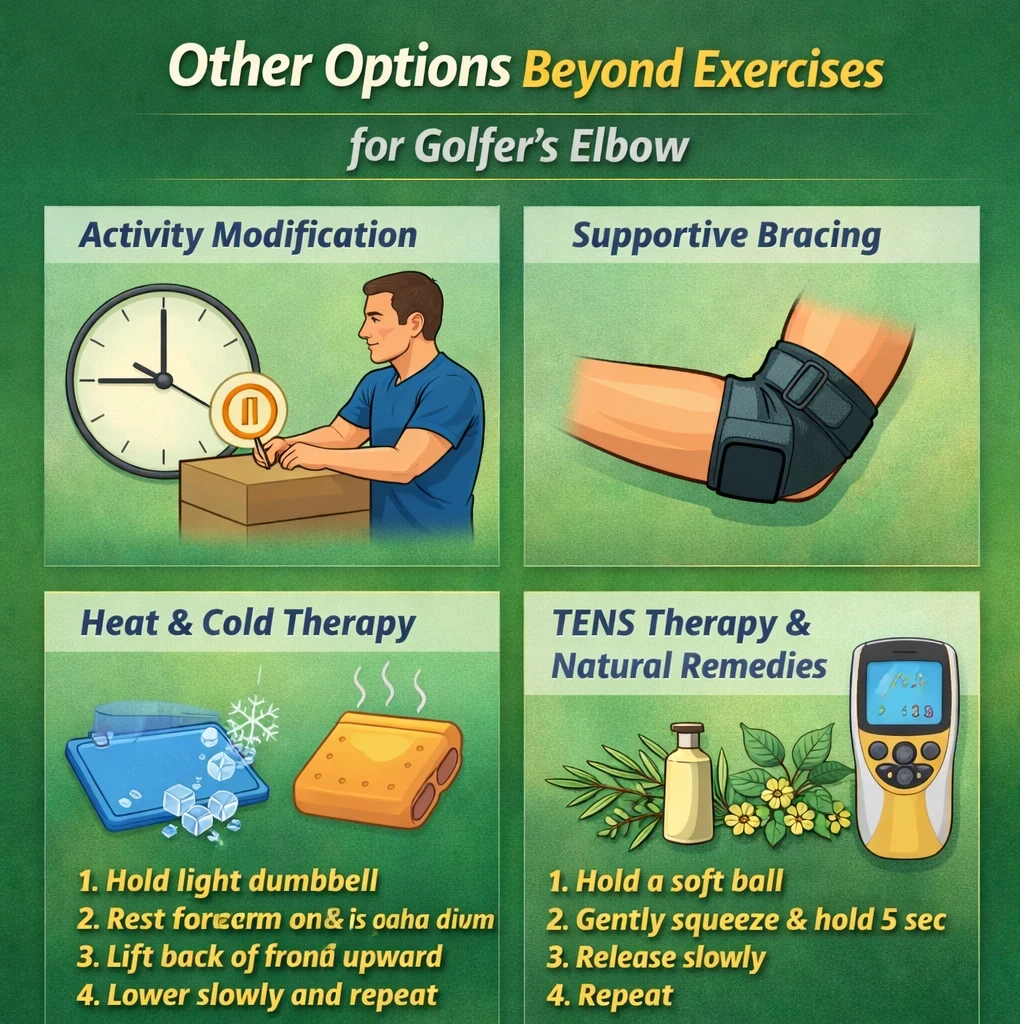
Other Options Beyond Exercises
While exercises are central, combining them with other supportive strategies often leads to better results.
1. Activity Modification
Reducing repetitive strain is crucial.
- Take breaks during repetitive tasks
- Adjust grip technique (especially in sports)
- Avoid heavy lifting during flare-ups
2. Supportive Bracing
Elbow straps or compression sleeves can reduce strain on the tendon during activity.
Shop for Supportive Elbow Bracing Here.
3. Heat and Cold Therapy
- Ice: helps reduce inflammation during flare-ups
- Heat: improves circulation before exercise
Shop for heat and cold therapy products for elbow pain Here.
4. TENS Therapy
Electrical stimulation may help reduce pain signals.
Shop for TENS Therapy Products for elbow pain Here.
Learn more here:
👉 what is TENS therapy and how does it work
5. Natural Recovery Approaches
Some people explore additional support options like herbal or anti-inflammatory approaches.
You can explore these here:
👉 herbs for sciatica pain relief natural calming
While not specific to golfer’s elbow, the principles of calming inflammation and supporting recovery are similar.
What Recovery Feels Like
Improvement is usually gradual.
You may notice:
- Less pain during gripping
- Improved range of motion
- Better strength over time
- Reduced morning stiffness
Full recovery can take weeks to months depending on severity.
When to Seek Professional Help
If symptoms persist despite consistent effort, consider:
- Physiotherapy
- Manual therapy
- Guided rehabilitation programs
Persistent pain may require a more structured approach.
Balanced Perspective
The best exercises for golfers elbow can be highly effective—but they are not an instant fix.
They work best when:
- Done consistently
- Combined with rest and recovery strategies
- Progressed gradually over time
There’s no single “magic” exercise. The real value comes from combining stretching, strengthening, and smart activity management.
Frequently Asked Questions
How long does it take for exercises to work?
Most people begin to notice improvement within 2–4 weeks, but full recovery may take longer depending on severity.
Should I stop exercising if it hurts?
Mild discomfort is normal, but sharp or worsening pain means you should stop and adjust.
Can golfer’s elbow heal without exercise?
It can, but recovery is often slower and less complete. Movement helps restore strength and function.
Are weights necessary?
No. You can start with bodyweight or very light resistance and progress gradually.
Scientific Reference
https://www.ncbi.nlm.nih.gov/pmc/articles/PMC3718355/