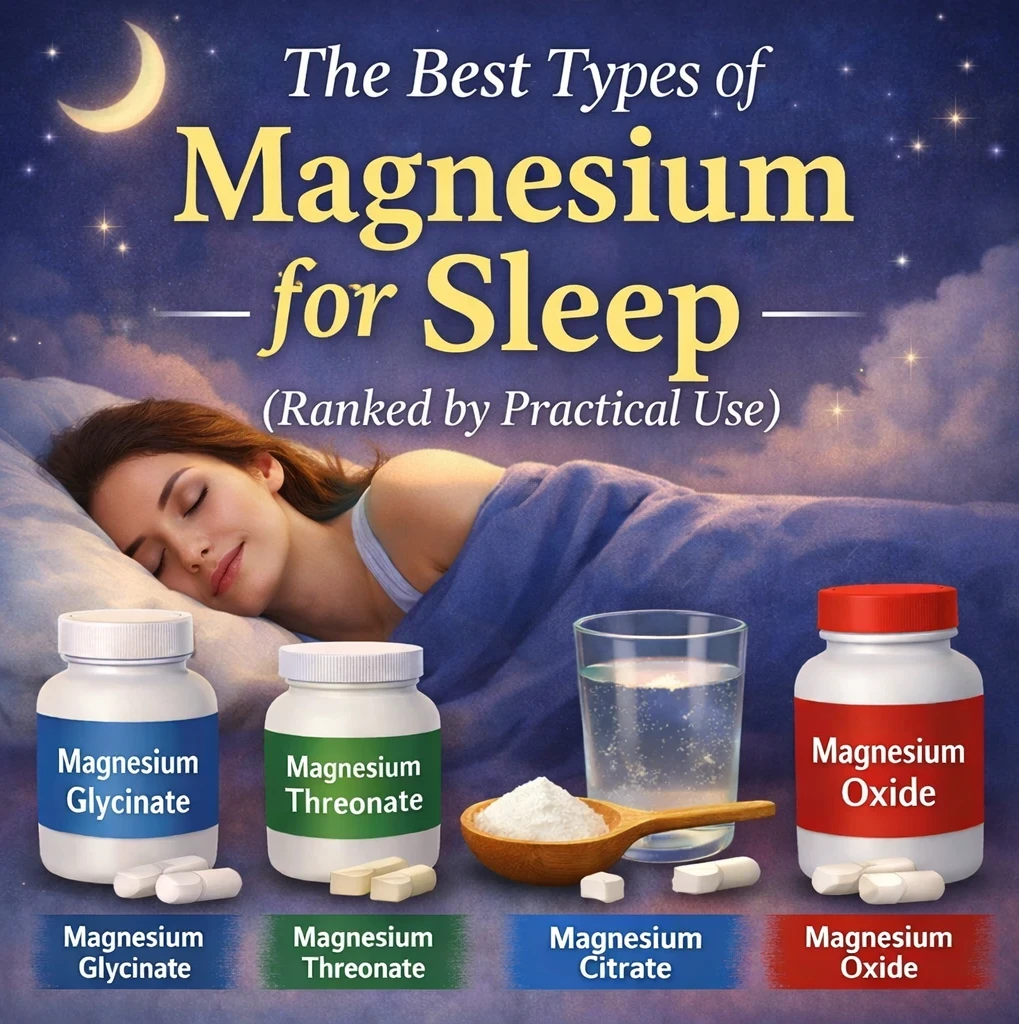
Best Types Of Magnesium For Sleep Expert advice
Best Types of Magnesium for Sleep
Best types of magnesium for sleep are becoming a common question as more people look for natural ways to improve rest without relying on heavy sleep medications.
If you struggle with falling asleep, staying asleep, or waking unrefreshed, understanding the best types of magnesium for sleep can help you choose the right form instead of guessing in the supplement aisle.
Magnesium supports nervous system regulation, muscle relaxation, and stress modulation — all critical factors in quality sleep. But not all magnesium supplements work the same way.
For more information on Magnesium for Sleep Supplements go here.
Why Magnesium Matters for Sleep Physiology
Magnesium has a major turtle to play when it comes to enzymes reacting in your body.
When it comes to sleep, it helps:
• Regulate GABA activity (a calming neurotransmitter)
• Balance stress hormones
• Relax skeletal muscle
• Support steady nighttime blood sugar
• Reduce nervous system excitability
If you’ve explored how stress influences pain perception in your article on
You’ll recognize the same principle here: when the nervous system is overstimulated, symptoms intensify — including insomnia.
Sleep difficulty is often less about “not being tired” and more about being neurologically wired.
That’s where choosing the best types of magnesium for sleep becomes relevant.
To find out more about which magnesium is the best for your situation go here.
The Best Types of Magnesium for Sleep (Ranked by Practical Use)
1. Magnesium Glycinate (Most Balanced Option)
Magnesium glycinate is widely considered the most reliable form for sleep support.
It combines magnesium with glycine, an amino acid that itself promotes calm. Glycine can help reduce core body temperature slightly — a natural signal the brain uses to initiate sleep.
Why it works well: • Gentle on digestion
• Low risk of laxative effect
• Supports anxiety reduction
• Helps muscle relaxation
If sleep difficulty is linked to stress, muscle tension, or nighttime overthinking, glycinate is usually the first recommendation when discussing the best types of magnesium for sleep.
For most adults, 200–400 mg in the evening is common, though individual tolerance varies.
2. Magnesium Threonate (For Mental Overactivity)
Magnesium threonate is newer and often marketed for cognitive support.
Its distinguishing feature is its ability to cross the blood-brain barrier more effectively than many other forms. This makes it potentially useful for people whose sleep struggles are driven by racing thoughts rather than physical tension.
It may help: • Reduce mental chatter
• Support memory and focus
• Improve subjective sleep quality
If your sleep disruption feels “brain-based,” threonate may deserve consideration among the best types of magnesium for sleep.
It tends to be more expensive, so it’s often a second-line option rather than a starting point.
3. Magnesium Citrate (Useful If Digestion Is Involved)
Magnesium citrate is well absorbed and widely available. However, it pulls water into the intestines and can have a laxative effect at higher doses.
It may be helpful if:
• Constipation is also present
• Sleep issues are linked to digestive discomfort
But if digestion is already sensitive, citrate may not be ideal when choosing the best types of magnesium for sleep.
4. Magnesium Oxide (Common but Less Effective)
Magnesium oxide is inexpensive and frequently found in budget supplements.
However:
• It has lower absorption rates
• It is more likely to cause digestive upset
• It provides less nervous system benefit compared to glycinate or threonate
For intentional sleep support, oxide is rarely considered one of the best types of magnesium for sleep.
For the best magnesium products to help you with sleep go here.
Matching the Form to the Problem
Instead of asking “What’s the strongest magnesium for sleep?” ask:
• Is stress keeping me awake?
• Is muscle tightness the issue?
• Is my mind racing at night?
• Is digestion contributing?
Stress + tension → Magnesium glycinate
Mental overactivity → Magnesium threonate
Digestive sluggishness → Magnesium citrate
This aligns with the broader nervous system education discussed in
https://beyond-pain-relief.com/movement-load-and-pain-sensitivity/
where overstimulation increases symptom intensity.
Sleep follows the same pattern.
What Magnesium Can and Cannot Do
Magnesium can:
• Support relaxation
• Improve sleep onset in mild insomnia
• Reduce nighttime muscle cramping
• Stabilize stress response
Magnesium cannot: • Override severe insomnia disorders
• Fix untreated sleep apnea
• Replace consistent sleep routines
• Work instantly like prescription sedatives
If sleep hygiene is inconsistent, magnesium will only have partial effect. Your article on
https://beyond-pain-relief.com/sleep-hygiene-tips-practical-habits-that-improve-sleep-quality/
naturally complements this discussion. Supplements work best when paired with consistent bedtime timing, reduced late-night stimulation, and proper light exposure.
For more information on the best magnesium supplements for quality sleep go to this website here.

Safety and Practical Dosing
General guidelines:
• Start low (around 200 mg)
• Take 1–2 hours before bed
• Increase gradually if needed
• Monitor digestion
Higher doses may cause:
• Loose stools
• Abdominal discomfort
• Daytime fatigue if overused
Anyone with kidney disease should consult a healthcare professional before supplementing.
Where Magnesium Fits in the Bigger Picture
Sleep disturbance is rarely isolated. It often connects to:
• Chronic stress
• Pain sensitivity
• Nervous system dysregulation
• Inflammation
• Anxiety
As discussed in
https://beyond-pain-relief.com/why-nerve-pain-ooccurs/
when the nervous system remains in protective mode, symptoms intensify. Sleep disruption is often part of that same protective response.
Choosing the best types of magnesium for sleep supports calming that system — but it works best as one tool among many.
Final Thoughts
The best types of magnesium for sleep are typically magnesium glycinate for balanced relaxation, magnesium threonate for cognitive calm, and magnesium citrate when digestion plays a role.
Magnesium oxide is common but rarely optimal for sleep-specific goals.
Magnesium does not sedate the brain — it supports the biology of relaxation. And when paired with strong sleep hygiene, stress regulation, and consistent habits, it can meaningfully improve sleep quality.
External Scientific References:
https://pubmed.ncbi.nlm.nih.gov/23853635/
https://pubmed.ncbi.nlm.nih.gov/35184264/