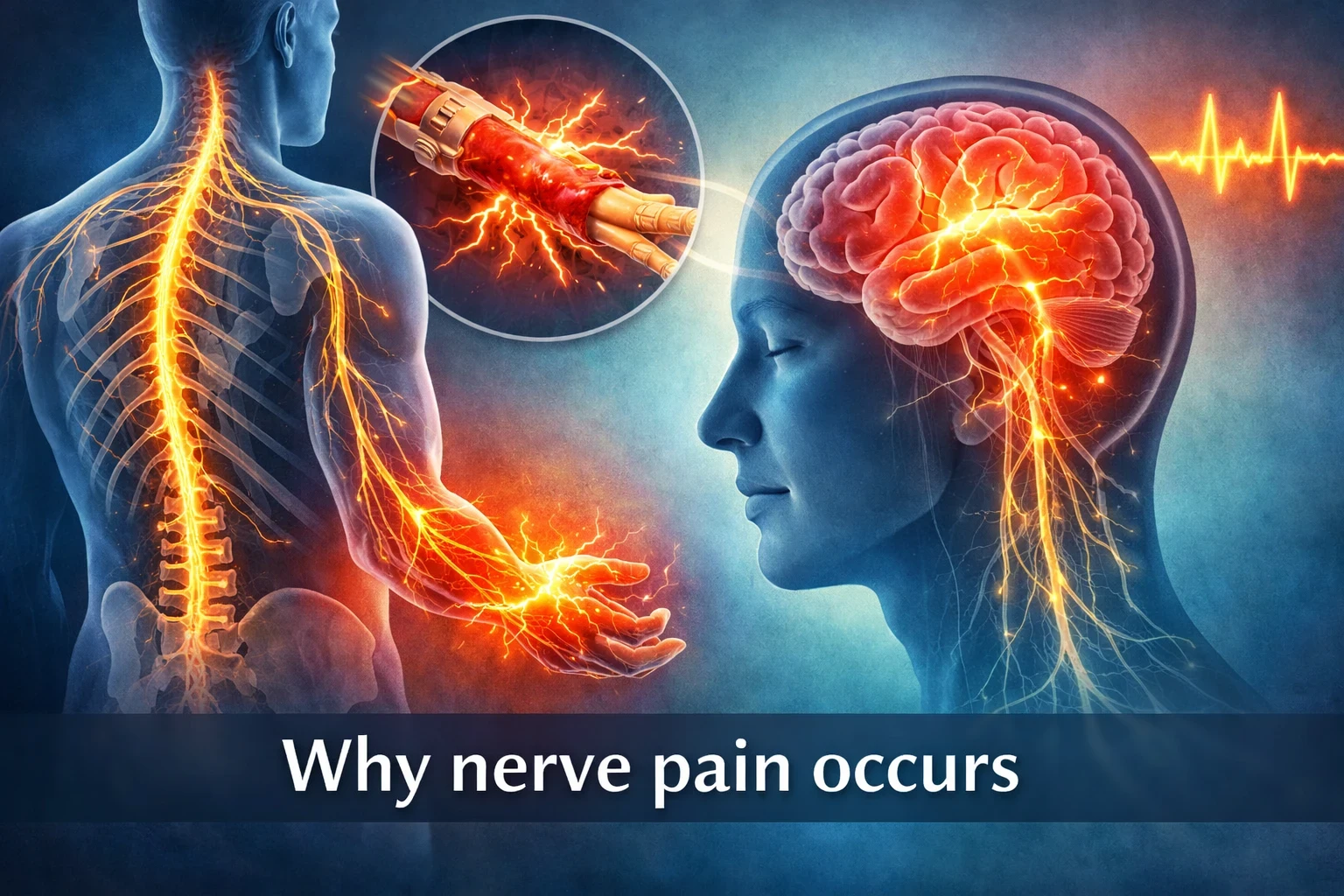
Why Nerve Pain Occurs
Why nerve pain occurs is not always easy to explain, especially when pain appears without a clear injury.
Many people feel confused, worried, or even dismissed when nerve pain continues.
If you find yourself in this position you are not the first
Nerve pain is real, and it deserves understanding, not judgement.
Nerve pain often feels sharp, burning, shooting, or electric. It can be intense and unpredictable.
It may flare for no obvious reason. These sensations can be frightening, but there are clear biological reasons behind them.
—
Understanding Nerve Pain in Simple Terms
Nerves act like messengers.
Nerves are carriers of information to your brain
This includes touch, temperature, movement, and warning signals. Pain is one of those warning signals.
When nerve pain occurs, these messages become distorted. Signals that should be quiet become loud.
Signals that should feel normal are interpreted as dangerous. The pain is not imagined. It is the result of a sensitive communication system.
This sensitivity helps explain why nerve pain occurs even when nothing looks wrong on scans.

—
Nerve Pain Is Not Always Damage
Many people believe nerve pain means nerves are permanently damaged.
This can be true in some cases, such as after surgery, infection, or long-term conditions like diabetes.
But damage is not always present.
In many people, nerves are still healthy but overreactive. They fire too easily. They send danger signals when there is no real threat.
During this period of overactivity it may feel like your body is broken, but this is not the case
It means the system is on high alert.
Understanding this point can reduce fear, which is important for recovery.
—
The Brain’s Role in Nerve Pain
Pain does not live in the nerves alone. Pain is produced by the brain. The brain’s job is to protect you. It decides when pain is needed based on incoming information.
When nerve pain occurs, the brain may become overly cautious. It may treat normal signals as threats.
Light touch, gentle movement, or mild temperature changes can trigger pain.
This helps explain why nerve pain occurs without visible injury. The brain is trying to keep you safe, even if the response is no longer helpful.
—
Nervous System Sensitisation
A key reason why nerve pain occurs is something called sensitisation. Sensitisation means the nervous system becomes easier to trigger over time.
Past injury, illness, repeated stress, or long periods of pain can all contribute.
The system learns pain. It remembers danger. Even after tissues heal, the alarm can stay switched on.
This is not a conscious process. It happens automatically. And it can be reversed.
—
Why Symptoms Change Day to Day
Nerve pain is often inconsistent. Some days are better. Others are worse. Pain may move or change its character. This can feel alarming.
These changes happen because pain is influenced by many factors.
Sleep, mood, stress levels, movement, and thoughts all play a role. When the nervous system feels under threat, pain increases. When it feels safer, pain may ease.
Fluctuation does not mean damage is spreading. It reflects a sensitive system responding to its environment.
—
Stress and Safety
Stress does not mean pain is “all in your head.” Stress changes how the nervous system functions. It increases alertness. It reduces recovery. It amplifies pain signals.
When stress is ongoing, the body struggles to switch into a calm state.
This makes nerve pain harder to settle. Learning why nerve pain occurs can reduce fear, and reducing fear helps restore a sense of safety.
Safety is essential for calming pain.
—

Compassion Matters
Living with nerve pain can be exhausting. It can affect sleep, confidence, and daily life. Many people push themselves too hard or blame their bodies.
Compassion is not weakness. It is a biological signal of safety. When you understand why nerve pain occurs, your nervous system no longer has to fight so hard.
Progress often comes in small steps. Knowledge is one of those steps.
—
Moving Forward
Nerve pain does not mean your body is damaged beyond repair. It means your nervous system has learned to protect you too strongly. With understanding, patience, and the right support, that system can learn safety again.
Learning why nerve pain occurs is not about ignoring pain. It is about listening differently.
—
Scientific Research References
https://pmc.ncbi.nlm.nih.gov/articles/PMC6431761/
—