Ergonomic Office Chairs For Back Pain Relief
Ergonomic office chairs for back pain relief
Ergonomic office chairs for back pain relief are increasingly important in modern work environments where long hours of sitting have become the norm.
Back pain rarely develops from a single cause.
Instead, it is influenced by posture, sustained loading, stress, movement habits, and how the nervous system adapts over time.
An ergonomic chair cannot solve back pain on its own, but it can play a valuable supportive role when chosen and used correctly.
Learn more here.

Prolonged sitting
Prolonged sitting places continuous pressure on the spine, particularly the lower back.
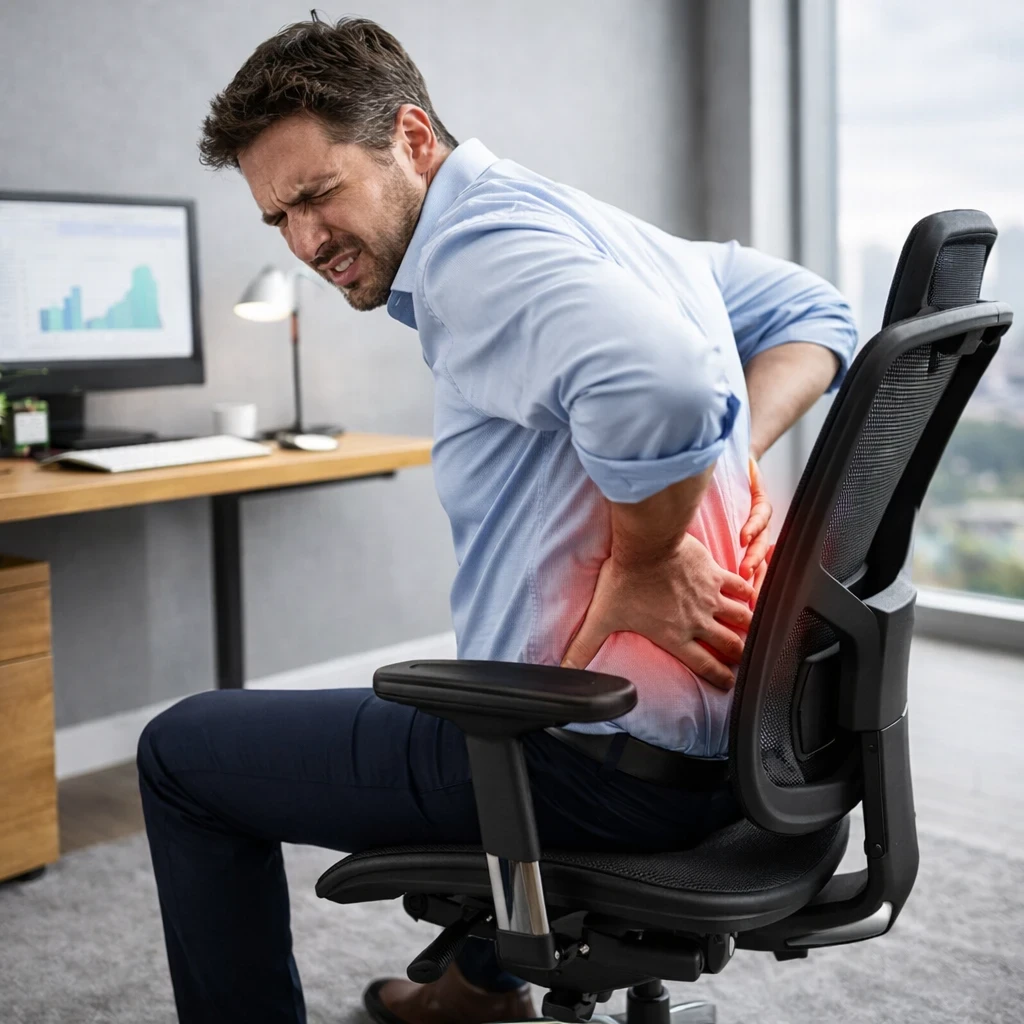
When a chair does not support the natural curves of the spine, surrounding muscles must work harder to stabilise the body.
Over time, this can lead to fatigue, stiffness, and increased pain sensitivity.
Ergonomic office chairs for back pain relief are designed to reduce unnecessary strain by supporting posture while still allowing subtle movement.
One of the most important features of an ergonomic chair is adjustable lumbar support.
The lumbar spine naturally curves inward, and flattening this curve through poor seating increases disc and tissue stress.
Chairs that allow lumbar height and depth adjustment accommodate individual body shapes rather than forcing users into a fixed position.
This personalised support aligns with the broader education-based approach promoted throughout https://beyond-pain-relief.com, where one-size-fits-all solutions are discouraged.
 https://amzn.to/3LU9I8a
Seat height and seat depth
Seat height and seat depth also influence spinal comfort.
When feet cannot rest flat on the floor, or when the seat edge presses into the thighs, posture and circulation are compromised.
A properly adjusted ergonomic chair allows the hips to sit slightly higher than the knees, supporting a more neutral pelvic position.
This reduces excessive spinal flexion and can ease lower back strain during prolonged sitting.
Many people notice that ergonomic office chairs for back pain relief help reduce daily discomfort by supporting the spine more effectively during long periods of seated work.
Backcrest
Backrest design plays a crucial role as well.
Chairs that allow controlled recline and dynamic movement help distribute load across different tissues instead of concentrating stress in one area.
Static sitting, even with “good posture,” can still aggravate pain if movement is restricted.
This principle reflects concepts discussed in chronic pain treatment options, where variability and gentle movement are encouraged rather than rigid positioning.
More on this approach can be found at https://beyond-pain-relief.com/chronic-pain-treatment-options/.
Armrests are often overlooked but significantly affect upper-body tension.
Poorly positioned armrests increase shoulder loading and promote slouching.
Adjustable armrests that support the forearms without lifting the shoulders help reduce neck and upper-back strain, which often contributes to or coexists with lower back discomfort.
Material choice
Material choice and cushioning also matter.
Very soft chairs may feel comfortable initially but allow excessive sinking, reducing spinal support over time.
Firmer, breathable materials maintain structure while improving comfort during longer work sessions.
Thermal comfort is another subtle factor, as discomfort can increase muscle tension and pain sensitivity.
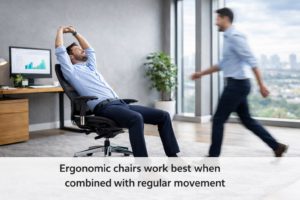
It is important to emphasise that ergonomic office chairs for back pain relief work best when combined with regular movement.
No chair can counteract the effects of sitting without breaks.
Standing,Stretching Walking
Standing, stretching, and gentle walking help restore circulation and reduce nervous system sensitivity.
Educational content on movement and pain sensitivity throughout https://beyond-pain-relief.com reinforces this principle.
Desk setup should also be considered. Monitor height, keyboard position, and desk height all influence how effectively a chair supports the body.
An ergonomic chair used at a poorly configured workstation will still place the spine at a disadvantage.
Viewing the chair as part of a complete workstation system leads to better long-term outcomes.
For people already experiencing persistent back pain, expectations should remain realistic.
An ergonomic chair can reduce aggravating factors but does not “fix” pain on its own.
Pain is influenced by sleep quality, stress, beliefs, and previous experiences.
This broader understanding is central to pain relief strategies beyond medication, explored further at https://beyond-pain-relief.com.
When choosing a chair, trialling different models is ideal.
Features such as adjustable lumbar support, seat depth, recline tension, and armrest positioning should be prioritised over appearance.
Individual comfort and fit are more important than brand reputation alone.
Supportive tools can also complement education and lifestyle changes.
A curated overview of helpful products, including seating supports and related tools, is available at https://beyond-pain-relief.com/products-related-to-chronic-pain-relief-that-are-available-on-these-trusted-websites/.
Summary
In summary, ergonomic office chairs for back pain relief are a valuable component of a supportive pain management strategy.
By reducing unnecessary strain, encouraging movement, and fitting the individual, they can make daily work more comfortable.
When combined with regular movement, education, and realistic expectations, ergonomic office chairs for back pain relief can play a meaningful supportive role in long-term comfort at work.
Scientific Studies
- Brewer, S., et al. (2006).
Workplace interventions to prevent musculoskeletal disorders.
Ergonomics, 49(2), 190–201.
https://pubmed.ncbi.nlm.nih.gov/16484039/ - Lis, A. M., et al. (2007).
Association between sitting and occupational low back pain.
European Spine Journal, 16(2), 283–298.
https://pubmed.ncbi.nlm.nih.gov/17036293/