Tietze Syndrome Vs Costochondritis Understanding The Differences
Tietze Syndrome vs Costochondritis:
Tietze Syndrome vs costochondritis is a comparison many people search for when chest wall pain becomes worrying, persistent, or confusing.
Both conditions can cause sharp or aching pain around the ribs and breastbone, often leading people to fear heart or lung problems.
While they share similarities, Tietze Syndrome vs costochondritis are not the same condition, and understanding the differences can reduce fear, improve self-management, and guide safer, more supportive care decisions.
Chest wall pain is surprisingly common, and when it appears suddenly, it can trigger anxiety and repeated medical visits.
Learning how Tietze Syndrome vs costochondritis differ helps people feel more confident about what’s happening in their body and what steps may help calm symptoms over time.
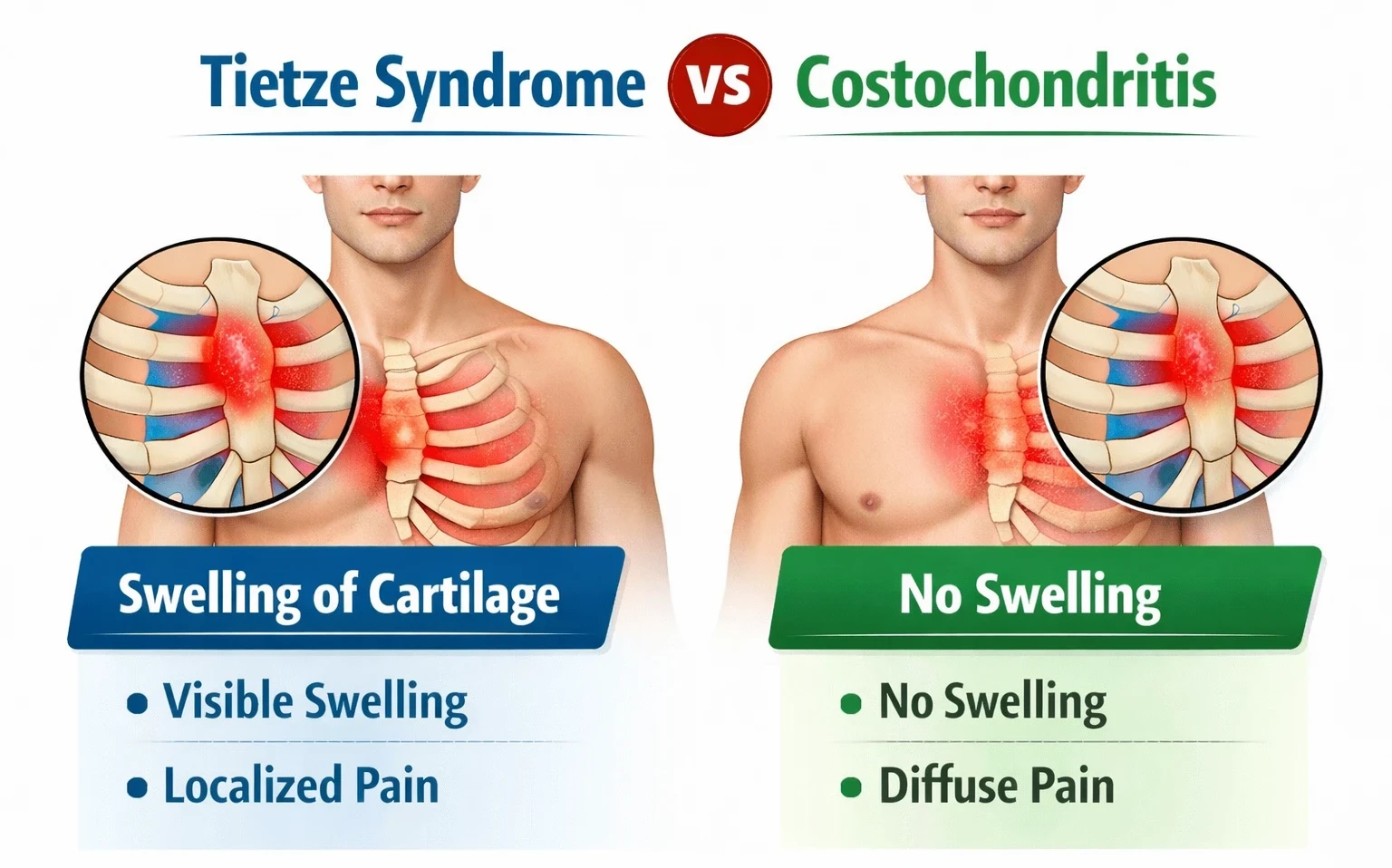
What Is Tietze Syndrome?
Tietze syndrome is a relatively rare inflammatory condition that affects the costochondral junctions—where the ribs meet the breastbone (sternum).
One of the defining features of Tietze syndrome is visible or palpable swelling over the affected rib cartilage.
Pain associated with Tietze syndrome often:
- Appears suddenly
- Affects a single rib (most commonly the second or third)
- Feels sharp, stabbing, or deep and aching
- Worsens with movement, coughing, or deep breathing
In discussions of Tietze Syndrome vs costochondritis, swelling is one of the most important distinguishing factors. Tietze syndrome is more commonly seen in younger adults, although it can occur at any age.
What Is Costochondritis?
Costochondritis is far more common than Tietze syndrome and involves irritation or inflammation of the same rib-sternum joints—but without visible swelling.
Pain is usually reproducible by pressing on the chest wall and may involve multiple ribs on one or both sides.
Costochondritis pain often:
- Develops gradually
- Feels dull, aching, or pressure-like
- Spreads across several ribs
- Flares with posture, overuse, or upper-body strain
When comparing Tietze Syndrome vs costochondritis, the absence of swelling and the broader distribution of pain usually point toward costochondritis rather than Tietze syndrome.
Key Differences Between Tietze Syndrome vs Costochondritis
Understanding Tietze Syndrome vs costochondritis becomes easier when the core differences are clearly laid out:
Tietze syndrome
- Rare condition
- Visible swelling present
- Usually affects one rib
- Often sudden onset
- More common in younger individuals
Costochondritis
- Common condition
- No visible swelling
- Often affects multiple ribs
- Gradual onset
- Seen more frequently in adults over 40
Despite these differences, both conditions are considered benign and non-life-threatening, even though symptoms can be intense and distressing.
Why These Conditions Can Feel So Alarming
Chest pain naturally triggers concern about the heart, lungs, or serious disease. With both Tietze syndrome and costochondritis, pain can radiate to the shoulders, arms, neck, or back, mimicking cardiac symptoms.
This fear response can amplify pain through nervous system sensitisation. Learning how the nervous system influences pain perception can be helpful, especially for people experiencing persistent or recurrent symptoms.
Resources such as why nerve pain occurs will explain how pain can feel severe even when tissue damage is limited.
What Causes Tietze Syndrome and Costochondritis?
The exact cause of Tietze syndrome is not always clear. Proposed triggers include:
- Minor chest trauma
- Repetitive strain
- Respiratory infections with heavy coughing
- Sudden increases in upper-body activity
Costochondritis is more often associated with:
- Poor posture
- Repetitive movements
- Heavy lifting
- Prolonged sitting or desk work
- Muscle tension around the chest and shoulders
When evaluating Tietze Syndrome vs costochondritis, it’s important to note that both conditions may involve mechanical stress combined with local inflammation and nervous system sensitivity.
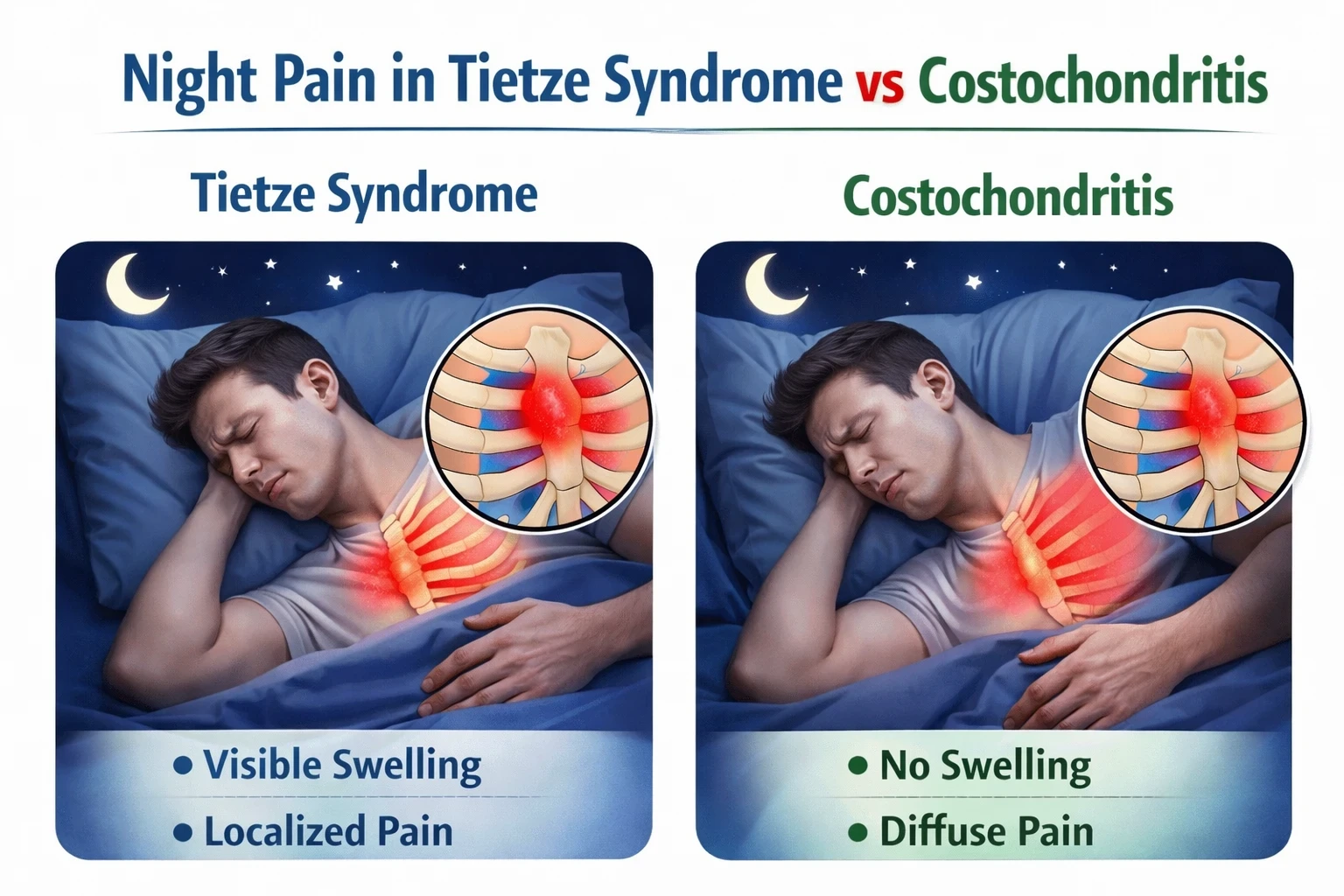
Diagnosis and Medical Evaluation
There is no single test that definitively diagnoses Tietze syndrome or costochondritis. Diagnosis is usually made by:
- Medical history
- Physical examination
- Ruling out cardiac, pulmonary, or gastrointestinal causes
Imaging such as X-rays, CT scans, or MRIs are often normal but may be used to exclude more serious conditions. Swelling on examination strongly supports Tietze syndrome in the Tietze Syndrome vs costochondritis comparison.
Supportive Management and Self-Care Options
There is no quick fix for either condition, but many people improve with time and supportive care.
Management often focuses on reducing irritation, calming the nervous system, and avoiding flare-up triggers.
Helpful approaches may include:
- Relative rest during flares
- Gentle movement rather than complete inactivity
- Heat or cold therapy
- Postural awareness
- Breathing exercises
Many people also explore options outlined in pain relief without medicationswhen symptoms persist or when medication is poorly tolerated.
For broader lifestyle-based support, strategies discussed in natural pain relief methods may help reduce overall symptom burden without aggravating sensitive chest tissues.
Prognosis: What to Expect Long Term
In most cases, both Tietze syndrome and costochondritis are self-limiting. Symptoms may last weeks to months, and in some people, symptoms can recur during periods of stress, illness, or overuse.
When comparing Tietze Syndrome vs costochondritis, Tietze syndrome may take longer to fully settle due to localized swelling, but long-term outcomes are generally good for both conditions.
When to Seek Medical Advice
Although these conditions are benign, medical assessment is essential if:
- Chest pain is new, severe, or worsening
- Pain occurs with shortness of breath, dizziness, or fainting
- There is unexplained fever or weight loss
- Symptoms change in character
Once serious causes are ruled out, reassurance and education often play a major role in recovery.
Final Thoughts on Tietze Syndrome vs Costochondritis
Understanding Tietze Syndrome vs costochondritis helps remove much of the fear surrounding chest wall pain.
While symptoms can be intense and disruptive, both conditions are manageable, non-dangerous, and often improve with time, education, and supportive self-care.
Recognising the role of inflammation, mechanical stress, and the nervous system allows people to approach recovery with confidence rather than fear.
Scientific Studies
https://pubmed.ncbi.nlm.nih.gov/18325363/
https://pubmed.ncbi.nlm.nih.gov/19564109/
 Next Post