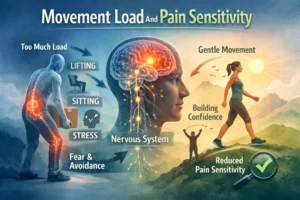
Movement Load And Pain Sensitivity
Movement, Load, and Pain Sensitivity
Movement, load, and pain sensitivity are closely connected. Many people believe pain means damage.
Modern pain science shows this is often not true. Pain is influenced by how the nervous system interprets movement and load over time.
This page explains how movement and physical load affect pain sensitivity. It also explains why avoiding movement can sometimes make pain worse rather than better.
Understanding this relationship can reduce fear.
Reduced fear often reduces pain.

Pain Sensitivity Is Not the Same as Injury
Pain is not produced directly by muscles, joints, or discs. Pain is an output of the brain. The brain creates pain when it believes the body is under threat.
In short-term injury, pain is protective.
In long-term pain, the protection system can become overactive.
This process is often called sensitisation. The nervous system becomes more alert. Safe movement can begin to feel dangerous. Normal load can feel overwhelming.
If this idea is new, it is explained clearly here:
how pain signals are generated
What “Load” Really Means
Load does not just mean weight.
It means any demand placed on the body.
This includes:
- Lifting
- Walking
- Sitting
- Repetitive tasks
- Posture held for long periods
- Emotional and mental stress
The nervous system responds to total load, not just physical effort. When load exceeds what the system feels safe handling, pain sensitivity can increase.
This does not mean damage has occurred.
It means the system feels overloaded.

Why Avoiding Movement Can Increase Pain Sensitivity
When pain is present, avoiding movement feels logical. In the short term, rest can help. Over longer periods, complete avoidance can increase sensitivity.
Why?
Because the nervous system learns from experience. When movement is avoided, the brain receives less evidence that the body is safe.
Over time:
- Muscles lose confidence
- Joints feel stiffer
- The nervous system becomes more protective
- Pain occurs with lower levels of load
This is common in long-standing pain conditions.
It does not mean the body is weak.
For a broader explanation of long-term pain patterns, see:
chronic pain health conditions
Movement as a Safety Signal
Gentle, appropriate movement sends a different message to the brain. It provides evidence of safety.
Movement does not need to be intense.
It does not need to be perfect.
It needs to feel manageable.
When movement is reintroduced gradually:
- Pain sensitivity often decreases
- Confidence improves
- The nervous system calms
- Flare-ups become less threatening
This is not about pushing through pain.
It is about building tolerance safely.
Load Is About Capacity, Not Toughness
Everyone has a different capacity for load. Capacity changes with sleep, stress, mood, health, and past experiences.
On a good day, capacity is higher.
On a poor sleep day, capacity is lower.
Pain occurs when load exceeds current capacity. This explains why pain can fluctuate even without injury.
This perspective helps remove blame.
Pain is not failure.
It is information.

Supporting Movement Without Increasing Pain
Movement support works best when combined with understanding and pacing.
Helpful principles include:
- Start below flare-up thresholds
- Increase load slowly
- Prioritise consistency over intensity
- Respect recovery
- Avoid all-or-nothing thinking
Movement is one part of a wider support approach. Many people also explore topical options, education, and lifestyle changes.
You can explore supportive tools here:
pain relief products and therapies
The Role of Fear and Expectation
Fear strongly influences pain sensitivity. If the brain expects danger, it is more likely to produce pain.
Education reduces fear.
Understanding changes experience.
Learning how movement, load, and pain sensitivity interact helps people regain trust in their body. This trust is often the first step toward improvement.
This wider approach is explained here:
pain relief strategies beyond medication
Final Thoughts
Movement, load, and pain sensitivity are not enemies. They are part of a communication system designed to protect you.
Pain does not always mean stop.
It often means adjust.
With understanding, patience, and gradual exposure, many people find their pain becomes less intense and less controlling.
Support should feel safe.
Progress should feel sustainable.
References
https://pmc.ncbi.nlm.nih.gov/articles/PMC11837743/
https://www.iasp-pain.org/publications/relief-news/article/pain-sensitivity/
Scientific Research
- https://www.jpain.org/article/S1526-5900(24)00366-3/fulltext
- https://pmc.ncbi.nlm.nih.gov/articles/PMC6085141/