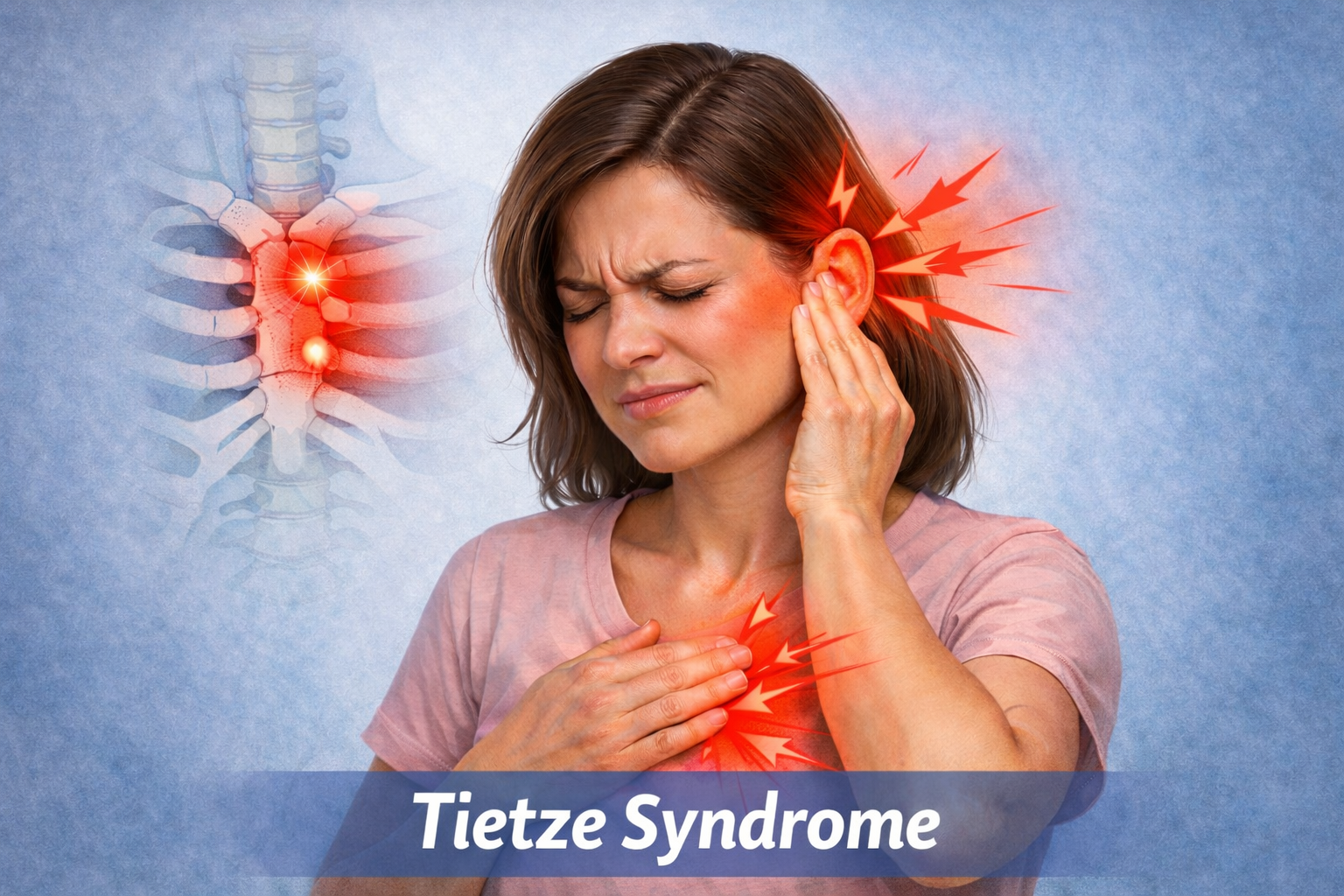
Tietze Syndrome A Calm Reassuring Guide For Patients
Tietze Syndrome
Tietze Syndrome is in some ways a misunderstood condition that can frighten when it happens first.
Chest pain can be frightening. Many people immediately worry about their heart — and that fear alone can make symptoms feel worse.
It is one possible cause of chest pain that sounds serious but is not dangerous.
Understanding it properly can ease anxiety and support recovery.
This guide explains the condition in clear, patient-friendly language, in line with the Beyond Pain Relief approach: understanding pain rather than fearing it.
What is Tietze syndrome?
Tietze syndrome is a rare inflammatory condition that affects the cartilage where the ribs connect to the breastbone (sternum).
This cartilage becomes irritated and inflamed, leading to localized chest pain and visible swelling.
Although the pain can feel intense and alarming, it does not involve the heart, lungs, or internal organs.
You can learn more about pain causes and pain relief beyond medication here.
Why does Tietze syndrome happen?
There is not always a single clear cause. In many cases, symptoms appear after mechanical irritation or overload of the chest wall, such as:
- Repeated coughing or chest infections
- Heavy lifting or sudden upper-body strain
- Prolonged poor posture, especially rounded shoulders
- Minor chest trauma (sometimes forgotten)
- Stress-related muscle tension
Pain does not automatically mean damage. In this condition, the tissue is irritated rather than injured.
Common symptoms
The condition usually affects one rib joint, most often near the upper ribs.
Common symptoms include:
- Sharp, aching, or pressure-like chest pain
- Noticeable swelling over a specific rib joint
- Tenderness when pressing the area
- Pain that worsens with deep breathing, coughing, twisting, or lifting
- Discomfort that may spread to the shoulder, neck, or arm
A key feature is that the pain is reproducible with touch, which helps distinguish it from heart-related pain.
You can learn more about pain causes and pain relief beyond medication here.
Tietze syndrome vs costochondritis
Tietze syndrome is often confused with costochondritis.
- Tietze syndrome involves pain with swelling and is relatively rare
- Costochondritis involves pain without swelling and is more common
Both conditions affect the chest wall and are benign.
How is it diagnosed?
There is no single test for Tietze syndrome. Diagnosis is usually based on:
- A careful clinical examination
- Ruling out heart, lung, and digestive causes
- Imaging such as ultrasound or MRI if needed
Doctors are right to rule out serious causes first. Once those are excluded, the symptoms become a reassuring diagnosis.
Is Tietze syndrome dangerous?
No.
What it is:
- Not life-threatening
- Not progressive
- Not permanent
The pain can be uncomfortable and unsettling, but the condition itself is self-limiting, meaning it improves with time.
Recovery and supportive care
There is no instant cure, but most people recover well with gentle, supportive strategies rather than aggressive treatment.
Helpful approaches include:
- Relative rest (avoiding aggravating movements, not complete inactivity)
- Gentle shoulder and chest movement
- Heat or cold applied to the tender area
- Calm, slow breathing to reduce chest wall tension
- Improving posture without forcing rigid positions
Complete rest can sometimes increase pain sensitivity, so gradual movement is often more helpful.
The role of stress and the nervous system
Chest pain is closely linked to the nervous system. When someone feels anxious or constantly checks symptoms, pain signals can become amplified.
Fear does not cause this syndrome, but it can intensify how pain is experienced.
Understanding that:
- Your heart is safe
- The tissue is irritated, not damaged
- Gentle movement is allowed
can significantly reduce pain over time.
When to seek medical help
Always seek urgent medical attention if chest pain is:
- New, severe, or crushing
- Associated with breathlessness, dizziness, or sweating
- Spreading without tenderness to touch
This advice is about safety, not alarm.
Living with it
Symptoms may fluctuate and flare during illness, stress, or over-activity. This does not mean harm is occurring.
With reassurance, confidence in movement, and time, symptoms usually settle.
A Beyond Pain Relief perspective
Tietze syndrome is a clear example of how pain does not always equal danger. Understanding what is happening in your body can reduce fear, calm the nervous system, and support natural recovery.
Pain is complex — but it is also adaptable.
Scientific References
- StatPearls – Tietze Syndrome (Clinical Overview)
https://www.ncbi.nlm.nih.gov/books/NBK564363/ - Kardiochirurgia i Torakochirurgia Polska (2018)
What do we know about Tietze’s syndrome?
https://www.ncbi.nlm.nih.gov/pmc/articles/PMC6180027/ - PubMed – MRI Findings in Tietze Syndrome
https://pubmed.ncbi.nlm.nih.gov/19032818/ - PubMed – Retrospective Analysis of Tietze Syndrome
https://pubmed.ncbi.nlm.nih.gov/25742551/ - Investigative Magnetic Resonance Imaging (2020)
Dynamic Contrast-Enhanced MRI Findings in Tietze Syndrome
https://i-mri.org/DOIx.php?id=10.13104/imri.2020.24.1.55 - PubMed – Scintigraphy and CT Findings in Tietze Syndrome
https://pubmed.ncbi.nlm.nih.gov/2680209/